North Georgia’s rugged mountains and dense forests provide the ideal habitat for one of the region’s most iconic wildlife species: the American black bear. Once nearly eliminated from the state due to unregulated hunting and habitat loss, black bears have made a remarkable comeback in Georgia’s northern counties, representing one of the Southeast’s greatest conservation success stories, thanks to government protections and dedicated local naturalists who make it their mission to educate the community on how to peacefully coexist with black bears.
And it just might be that the American black bear of North Georgia has no greater friend today than Cherry Log resident Gerald D. Hodge Jr. and his wife, Connie, who in 2019 formed the Appalachia Georgia Friends of the Bears (AGFOB), a nonprofit organization that does for the bears what they can’t do for themselves — talk to humans, share their story and inform people how to be a good neighbor to these ancient natives.
Bear Loss and Recovery
Black bears thrived in North Georgia for centuries, but even before Thomas Jefferson penned the Declaration of Independence, there was trouble brewing for them.
“As early as 1761, the Upper Creek Mortar noted to the governor of the Georgia colony that white encroachment up the Savannah River were killing bears, buffalo and deer so much that they did not have meat to feed their families,” Hodge confirmed. “The colonists killed anything that was a threat to their livestock and crop.”
And by the early 1900s, black bear populations in Georgia had dwindled to critically low levels, with only isolated populations surviving in the most remote mountain areas. Widespread habitat loss from logging and farming, as well as unregulated hunting by a populace that considered black bears “vermin,” left the once-flourishing population down to a mere few hundred.
Recognizing the species’ precarious situation, the state of Georgia, starting in the 1920s, established protective measures, including regulated hunting seasons and habitat preservation efforts. These conservation initiatives, combined with the bear’s natural adaptability, have allowed populations to rebound significantly over the past several decades.
Today, biologists estimate that approximately 5,000 black bears inhabit Georgia, with the vast majority — 3,000 to 4,000 — residing in the North Georgia mountains. This population has expanded from core areas in the Chattahoochee National Forest to include surrounding counties, demonstrating the effectiveness of sustained conservation efforts.
You Have a Friend in Me
Hodge remembers like it was yesterday standing beside Highway 515 in his church clothes on a Sunday morning in June 2019, examining a male black bear yearling that had been killed by a vehicle during the critical June bear family breakup period. That heartbreaking encounter — witnessing a young bear’s life cut short just one week after gaining independence — stirred up George and Connie’s passion to “do something.” When they called the Sheriff’s Department and the Georgia Department of Natural Resources (DNR) and found little help, they decided to act and soon afterward created their nonprofit organization, AGFOB.
Hodge, a retired U.S. Army lieutenant colonel who serves as the organization’s founder and CEO, regularly conducts public educational presentations throughout North Georgia. These sessions teach residents and visitors about bear behavior, proper food storage and the importance of securing attractants like garbage, pet food, bird feeders and barbecue grills.
“We have a small group of humans that are the doers,” Hodge explained. “We make things happen on the ground. We each have our own social networks that inform us about the community’s human issues.”
One of their strengths is their partnerships and sharing of resources with other government and nonprofit groups at the local, state and federal level to help bears thrive in North Georgia. “It will take every advantage to protect the Appalachian Georgia American black bear and its shrinking world,” Hodge exclaimed.
More Work to Do
As bear populations have recovered and human development has expanded into mountain communities, encounters between people and bears have become increasingly common. Most conflicts arise when bears seek easily accessible food sources near homes. These “food-conditioned” bears can become problematic, losing their natural wariness of humans and potentially creating safety concerns.
AGFOB emphasizes that preventing human-bear conflicts requires proactive community engagement. Residents in bear country are encouraged to secure garbage in bear-resistant containers, remove bird feeders during active bear seasons and eliminate other attractants from their properties.
“It will take the continued efforts of the local communities to slow or stop the overdevelopment and habitat loss,” Hodge said.
Another important step is to advocate for local laws that protect endangered wildlife like the American black bear. “Make it illegal to feed wild bears!” Hodge exclaimed. “In the state of Georgia, it is illegal to feed wild alligators but not wild bears? Where in the realm of common sense does that exist? We do not see a lot of wild alligators on social media being lured on humans’ back decks with pizza, honey and other human-provided food. Today there is general agreement … that most human/bear conflicts are the result of human behavior. Bad human behavior begets bad bear behavior.”
The solution is simple, he says: respect the bear’s habitat and avoid contact with bears, no matter how cute and cuddly they look. It’s best to just let them go about their business, and you go along with yours without a marathon selfie session.
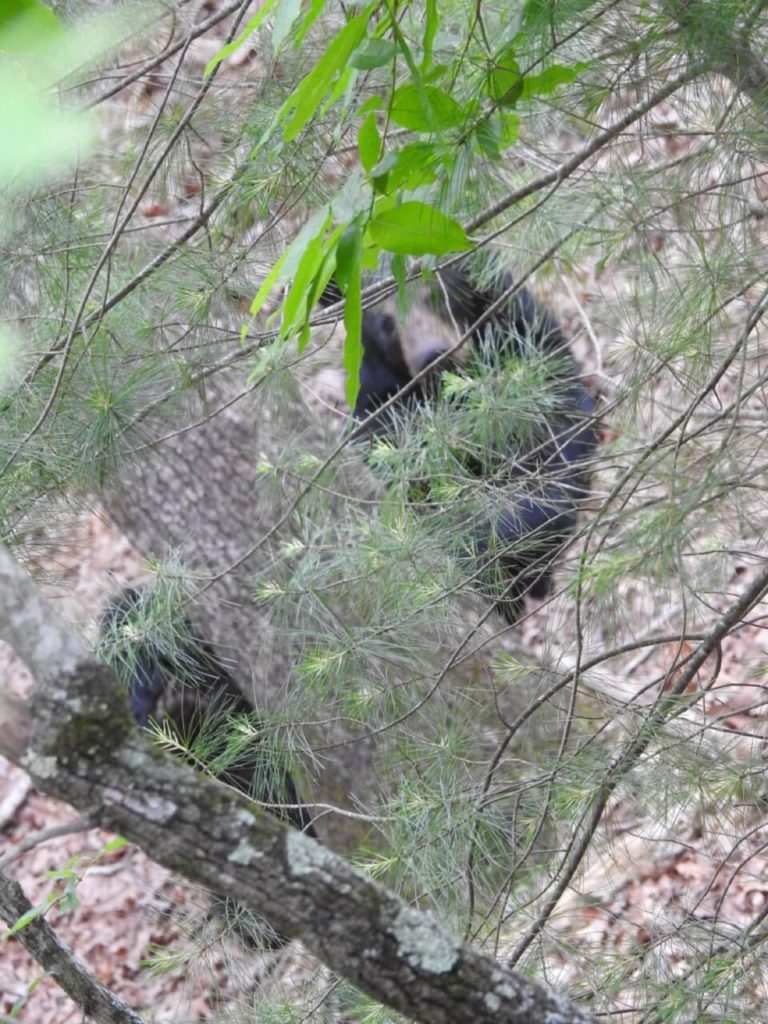
One of Hodge’s most memorable moments while working for AGFOB happened during the height of the pandemic when a woman called and said she had “three orphaned cubs” stuck in a tree in her front yard.
“I knew immediately that they were not orphaned,” he explained. “Mom and her cubs just left the den a few weeks before, and the cubs are very small and cannot keep up with mom very well. Mom will put the cubs up in what we call a ‘babysitter tree.’ She will leave them for one to three hours to go forage.”
Thankfully, the woman took his advice to heart, brought in her dogs and stayed away from the tree. Soon the mother returned, and off they went into the woods. But if a mother feels threatened by humans or dogs are surrounding her babysitter tree, she might abandon her cubs, which will then have to be euthanized. That’s definitely a tragedy that can be avoided by having some bear sense.
Research and Road Safety Initiatives
Perhaps AGFOB’s most significant achievement has been its groundbreaking work on vehicle-bear mortality. In cooperation with its partners — Georgia DNR, Georgia Department of Transportation (GDOT) and the Gilmer County Sheriff’s Department — the organization completed a study of black bear road-kills in Georgia, specifically along Highway 515 between Ellijay and Blue Ridge, resulting in GDOT installing the first bear-crossing signs in North Georgia.
The organization’s roadkill response protocol demonstrates its commitment to scientific rigor and dignity for wildlife. It might seem like tragic work, yet it also offers hope, as the valuable data gleaned from accidents can help prevent them from recurring in the future. When responding to incidents, volunteers collect scientific data, photograph the scene, conduct external examinations, extract premolars for aging analysis and provide comprehensive written reports to Georgia DNR.
Grin and Bear It
For residents and visitors in North Georgia, black bears are more than a mere mammal; they represent a connection to the region’s wild and noble heritage. By respecting these magnificent animals and taking practical steps to minimize conflicts, we can ensure that future generations will continue to share the mountains with thriving black bear populations.
Want to help protect Georgia’s black bears or volunteer with Friends of the Bears? Please visit agfriendsofthebears.com or BearWise.org.